
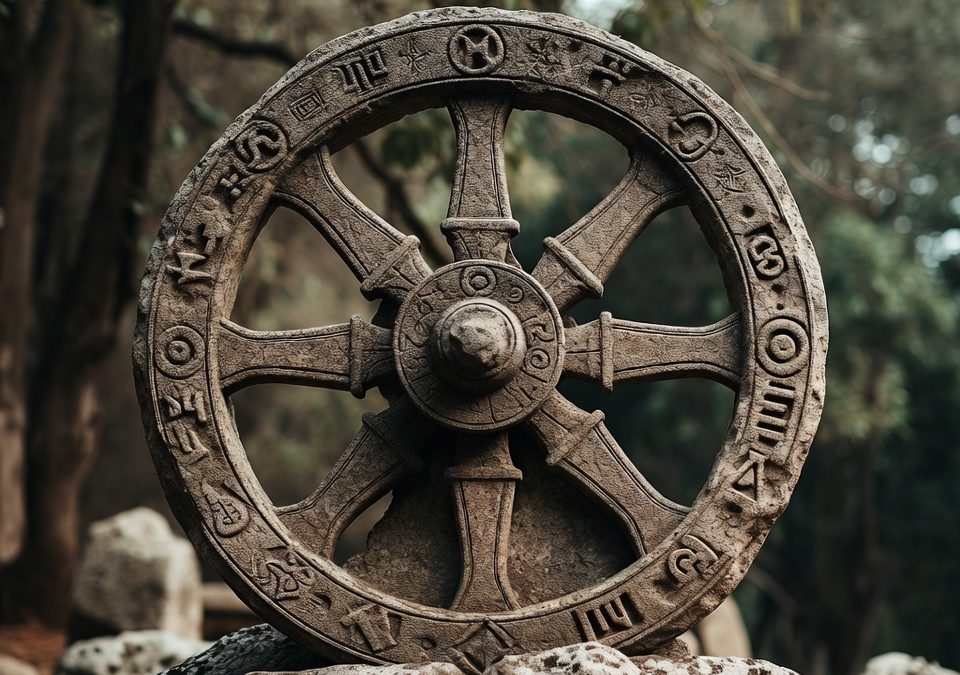
Cyclical Time Versus Linear
The old ones, those who came before cities and sundials, did not count revolutions of the earth as an expectation of ending, but as a promise of return. Their days were not measured in straight lines; they observed the swelling moon and the ever-dying sun, the way blood darkened and dried, and they understood that time was a wheel, not a river. In the seasons, in the decay of fruit, in the hush of winter and the pulse of spring, they read the future and remembered the past. For them, the end was never final—each death was the soil for a birth, each burial a planting, each withdrawal of light a prelude to some daybreak.
To shepherd this wheel, rituals were woven into the marrow of existence. Sacrifice was not mere theater, but the axis around which the world turned: goats and grain, blood and hymn, sweat and ecstatic trance, all given so the wheel would not halt in its spinning. They did not perform these rites for comfort or habit; they believed, with a certainty that brooked no irony and no godless doubt, that if the proper words were not spoken, the right veins not opened, the world would stagger and collapse into darkness. It was not a metaphor but a law, as binding as gravity, as urgent as hunger. But when the Nazarene’s blood dried on the hill and the veil was torn, something broke in the wheel. Linear time — a broad, single road with a beginning and a foreordained end—swept over the old cycles like wildfire through dry grass. Now history was a story, not a loop, a narrative with climax and apocalypse – the one and only, like an exclusive end-show: Christian apocalypse. It was written once and would be read only once, from Genesis to Revelation, dust to dust. Progress replaced recurrence; pilgrimage replaced festival; the self replaced the clan. The old festivals of return and renewal became anniversaries, memorials of things that would never come again, commemorations of the world’s waning energy.
In this new world, the body became a clock, not a spirit-echo of the world’s endless circles.
Man was taught to expect a single death, a single resurrection, a single chance. He was no longer a guardian of balance, but a lonely archivist, standing on the shore and watching the tide recede, bravely (or desperately) marking the passage of hours and centuries even as the meaning of each moment grew thinner and paler, like the ghost of a ritual in a language nobody remembered how to speak.
The loss of rhythm was not only metaphysical but intimate, as if something in the bones rebelled against the new order of things.
No longer aligned with the pulse-beat of the moons and tides, the soul paced and jittered, uncertain how to persist in a timeline that cared little for return.
Some tried to reconstruct the old dances in the ruins of the temples, others abandoned memory altogether, running forward as if velocity could fill the void left by the absence of cycle. Most simply did not notice, and yet the landscape of the heart grew ever more barren, the seasons of happiness and grief no longer predictable, no longer anchoring, but erratic and cruel.
Question remains:
What happens to a person who lives without a sense of rhythm and repetition? To a person, as to a nation?